
Pre-Raphaelitism, The Three Graces... and Me
“My Aunt Aglaia, her cousin Mary Cassavetti, and Marie Stillman were known as ‘The Three Graces’. They were, for a considerable period, inseparable, and brilliant each in her own way.”
Ion, A Grandfather’s Tale by Alexander C. Ionides Junior
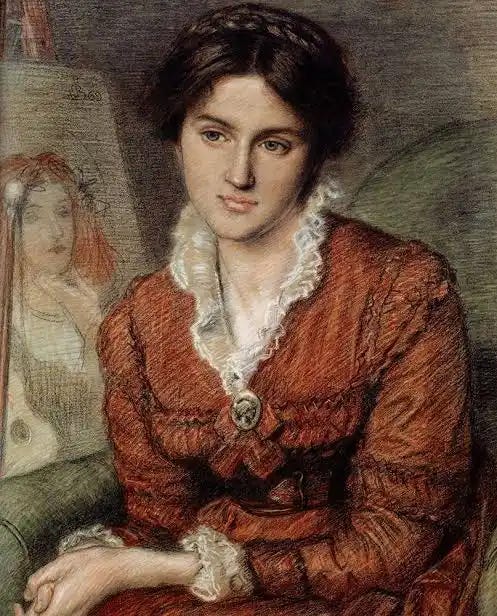
When Marie Stillman died in 1927, four days short of her 84th birthday, she left behind a rather exceptional artistic legacy. There had been many other female artists involved with the Pre-Raphaelite Brotherhood, from the much-talked about Ophelia model Elizabeth Siddal, Christina Rossetti with her acerbic poetry, and Evelyn De Morgan, whose figural, fairytale-like paintings are wholly distinctive. And yet, almost no other professional artist from the movement managed to work for as long as Marie Stillman did. Six decades, over one hundred and fifty works. Her Enchanted Garden sold for 874,500 GBP at Christie’s in 2020, the highest for any female Pre-Raphaelite ever. Her beauty will endure and remain forever, through paintings such as Rossetti’s A Vision of Fiammetta and in Julia Margaret Cameron’s soft focus photography. There is much to admire about Marie Stillman, from her gracious personality to her absolute determination to pursue art at a time when women were still not at liberty to do so independently. In 2023, she was commemorated with a Blue Plaque at her family’s home in Clapham, London.
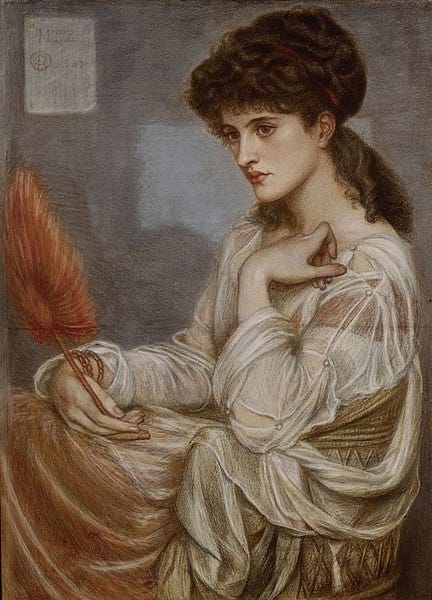
Maria Zambaco died on 37 Boulevard Beaumarchais, Paris, in 1914. Her death was only noted on The Daily Express — notably missing, however, were mentions of her life and work. Mentions of Maria Zambaco can be found on most modern biographies of Edward Burne-Jones; after all, she was his lover and muse. “Exuding sexuality,” one writer describes Maria at age 23. Others agree: “flamboyant woman of experience,” with “flattering suggestiveness.” Maria’s journey, fleeing from an unhappy marriage to a Greek doctor in France and returning to her mother’s home in London, only to end up in the arms of a very much married Pre-Raphaelite legend, has made her a notorious figure in the history of art. Suggestions of her loose morality are presented with barely-veiled misogyny by countless of these art historians, but even her contemporaries, like Dante Gabriel Rossetti, likened her to a hysterical Cassandra figure. Maria Zambaco posed for countless temptresses and vixens in Burne-Jones’ work, but hardly any notice has been paid to her extensive, award-winning work as a sculptor and medallist. She studied art with Auguste Rodin and Alphonse Legros, and at the Slade School, and exhibited in London, Paris and Athens. Maria’s face lives on only to haunt, at the Lady Lever Gallery in Liverpool, at the Victoria & Albert Museum in London and at Birmingham Museum. She remains there, trapped in her roles as Nimue, Phyllis, Galatea, Venus, Temperance, Psyche, Hermia.
In August 1906, the Westminster Gazette wrote of the “suicide due to temporary insanity” and “a mother’s determined suicide”. The mother in question was 72-year-old Aglaia Coronio, whose 50-year-old daughter Calliope died due to illness the previous day. Mrs. Coronio then stabbed herself 20 times in the neck and abdomen with sewing scissors. A witness asked her why she did what she did - apparently, her reply was, “it is my broken heart’. There is nothing in the article about Mrs. Coronio’s life, her background or her work. Aglaia Coronio is remembered mostly for her functional role as William Morris’ friend and confidante. Morris even taught her bookbinding, an activity which Marianne Tidcombe believes to have made Aglaia the first female bookbinder in Britain. Sporadic mentions of her connection to Burne-Jones come up, assisting him in costume designs. Finally, her family - the formidable Ionides Family - seem to have spent quite literally a fortune on paintings by the Pre-Raphaelites and their associates, and Aglaia is quite neatly placed in the role of art collector.
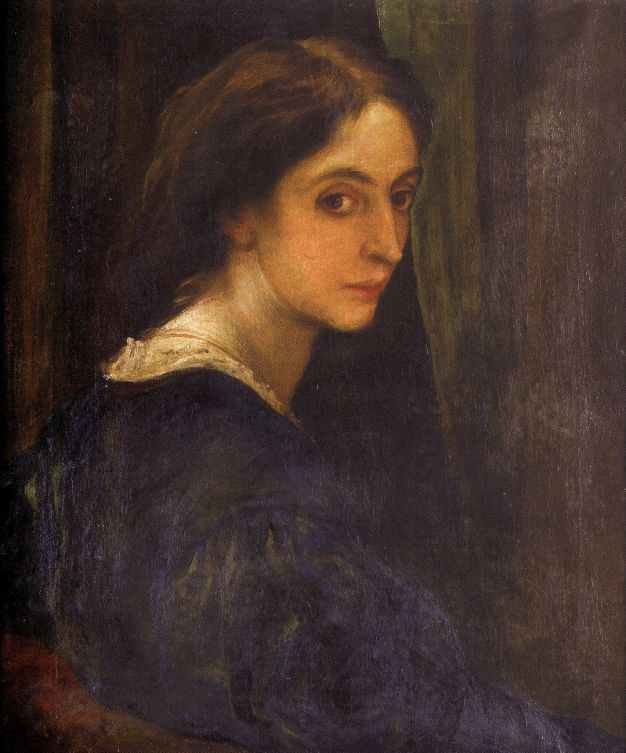
What do these three women have in common, besides their involvement in Britain’s first modern art movement?
They’re mostly remembered by face, and not by name; they were closely related; and, they were Greek. (Yes, Greek and not British women of Greek descent - they were born in England, but none considered themselves British or even English. Zambaco exhibited as a Greek artist and lived in Athens for many years; Spartali Stillman believed herself to be stateless, but with a Greek identity; Coronio was raised as a Greek diplomat’s daughter. All three were othered for their foreign manners, accents and “exotic” looks. Their heritage is the connecting thread that distinguishes their artistic output and lasting influence within the PRB.)
As of May 2026, I’m in the process of re-drafting my 80,000 word biography of Marie Spartali Stillman, Maria Zambaco and Aglaia Coronio. I do not know yet if it will ever be published, but I feel compelled to uncover as much as possible about their lives and hopefully help restore them to their rightful place amongst the history of the PRB. For the latter two women, this will be the first time anyone’s attempted to do so. For Marie Spartali Stillman, two very helpful and well-written biographies already exist, but neither to my understanding attempted to research the Greek side of her background. As I am Greek myself, I have made many trips to various archives across Greece, contacted living relatives of their families there as well as other art experts who are familiar with their lives. Finally, as I am also a filmmaker (and actor/writer) I wrote a short film titled THE THREE GRACES which is coming out this year and will function as a proof-of-concept for a potential TV series. More on that coming soon :)
As the story goes, Maria Cassavetti, Marie Spartali and Aglaia Ionides were referred to as The Three Graces in Victorian Art circles, due to their beauty, grace and Greek heritage. Though hugely influential artists and models in their time, their vast contributions to the art world are entirely forgotten, and that is what I am determined to amend. I am heartbroken by the idea that their lives have now become mere footnotes in the lives of Great Men. Their stories have, thus far, mostly been told with outrageous amounts of misogyny. It’s important to me that the historic and extensive contributions of Greek immigrants within the United Kingdom are acknowledged and considered, especially within such an artistic context.
Overall, it’s a story of defiance, independence, and sisterhood. It means the world to me. I have poured my heart and soul into researching these women for nearly five years, and whether it’s through blog posts, short films, a future TV series or a biographical book dedicated to Marie, Maria, and Aglaia, I hope that one day I can help them be remembered as they deserve.
I’ll be using my Substack to talk about the Graces, my work as a writer and filmmaker, offering Pre-Raphaelite reviews and updates on my research. And, hopefully, get you as obsessed with these wild and unpredictable Greeks as I am.
I shared this well written article with a friend whose mission is bringing to light the “lost women” of the Arts